


RECORDING: Fr Robbie’s Reflection on the Promise of Obedience

In this month’s session, Fr Anthony Robbie, Conventual Chaplain ad honorem reflected on the virtue of obedience and the Second Class of the Order. He dove deep into articles from Chapter 2 of the Code in CC&C 2022 and gave the participants valuable guidance in cultivating what is the hardest virtue – obedience.
Report of the session from Prof David Kissane, Regent of the Subpriory of the Immaculate Conception.
Obedience is a virtue modelled by Christ through his passion and death on the cross in completion of his Father’s will. Whereas the sin of Adam and Eve was based on pride, it is the virtue of humility that empowers the growth of Obedience.
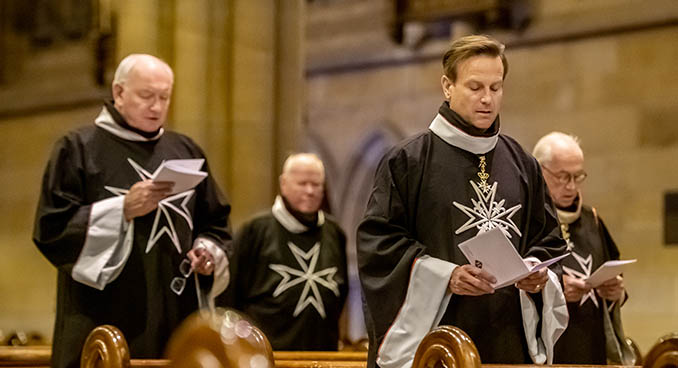
In the 1950’s the Second Class was created to assist the Professed, who are central to the life of a lay religious Order. Living in Obedience became a way to draw closer in prayer to the Professed Knights. The word “religion” really means a “binding” or a “rule” through which service is given to the Order one has come to love. It is a vocation requiring an aptitude, willingness to pursue and an invitation from the Holy Spirit.
In the CC&C 2022, the member in Obedience is bound to the spirituality of the Order (Art. 66), with the duty of prayer, deeper service and availability to the Order. This active commitment to the Order provides an example to others in the Church of good servants. A spirit of poverty also prevails with an austere control over retention of personal possessions.
Initially, a member starts with a Temporary Promise so that the spiritual duties (Art 74) are practised and eventually interiorised into the life of the person. This participation requires prayers in common, attendance at frequent Masses, and tasks being undertaken through the local works to uphold the charism of the Order.
The problems of Obedience arise when a requested task is distasteful or burdensome, requiring generosity to respond. Growth of the virtue comes through such adversity. However, if a superior requests a task that is sinful or contrary to God’s law, there is no authority behind such a request. Being asked to lie, do immoral acts, or vote in a certain political way – these are improper requests and can be ignored. The exercise of authority is a solemn act that can never be a burden to the conscience of another.
Ultimately, Obedience has its origin in our duty to God. Through our imitation of Christ, we seek sanctification and a holiness that is pleasing to God. The pathway of the Promise of Obedience is provided by the Order to deepen the spirituality of its members who discern this vocation to be apt for them.